[01] Context
A library is only useful if you can get your tools into it.
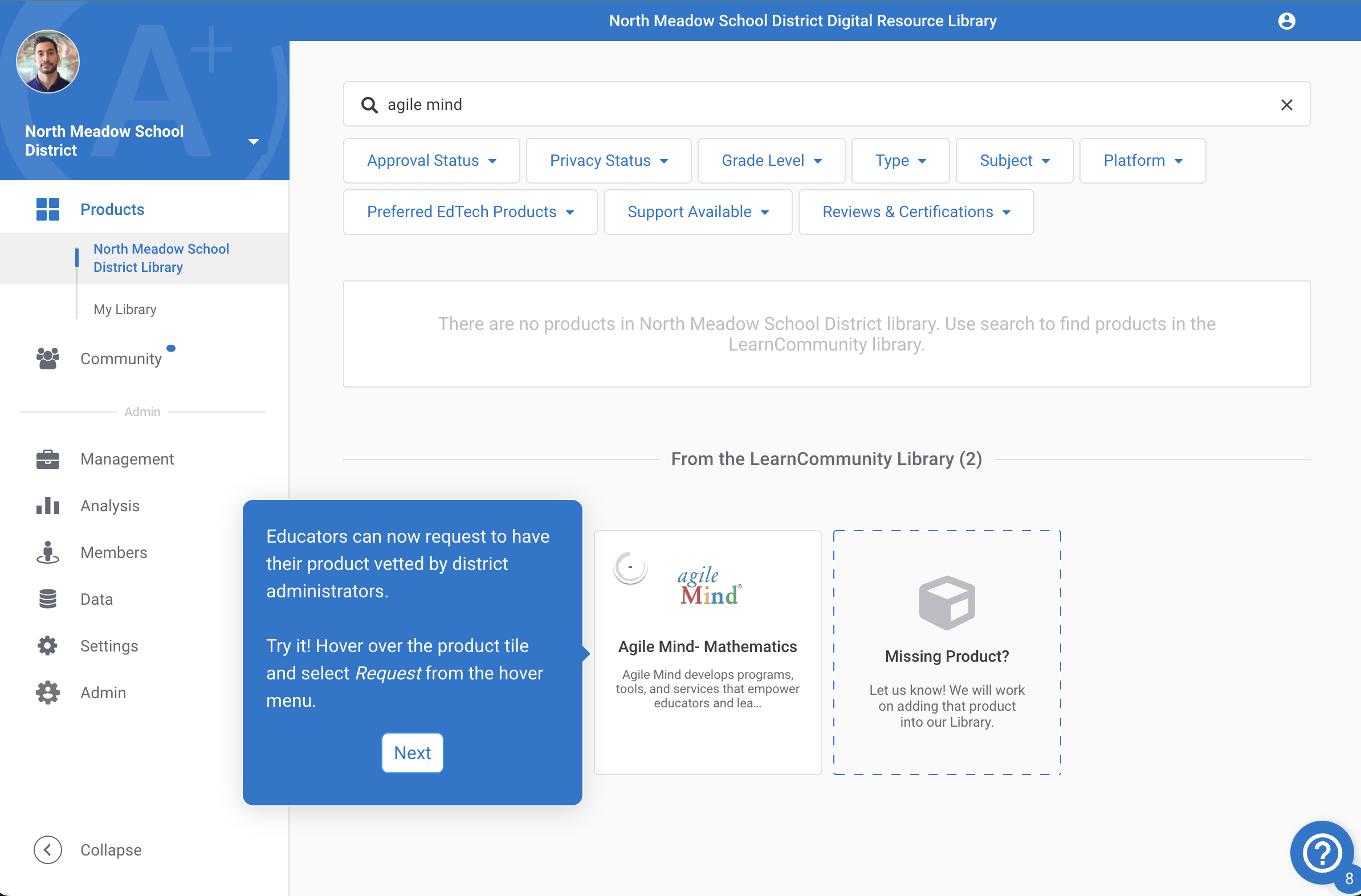
LearnPlatform helps education agencies discover, vet, and manage their edtech. Missing products stalled that work at the first step.
Read more about the context
One ecosystem. Many responsibilities.
Local and state education agencies use LearnPlatform to coordinate privacy, compliance, interoperability, efficacy, and accessibility reviews. A product first had to exist in the library before those workflows could begin.
My contribution
I led product work across investigation, workflow mapping, prioritization, and phased delivery, working with engineers, designers, contractors, and customer success managers.
[02] Problem
Every request joined the same queue.
Manual processing delayed vetting. Duplicate requests increased the workload, while “added” was often mistaken for “approved.”
- 01SearchEducator
- 02RequestMissing product
- 03Manual review5–20 min per request
- 04CreateContractor
- 05VetDistrict administrator
- Requests duplicated existing products
- ~25%
- Time to value before the change
- ~14 days
[03] Approach and decisions
Follow the request. Find the friction.
Interviews, request data, and prototypes made the hidden handoffs visible—and shaped a staged release.
- Request data reviewed
- 2.5 years
- Educators · admins · contractors · CSMs
- 4 perspectives
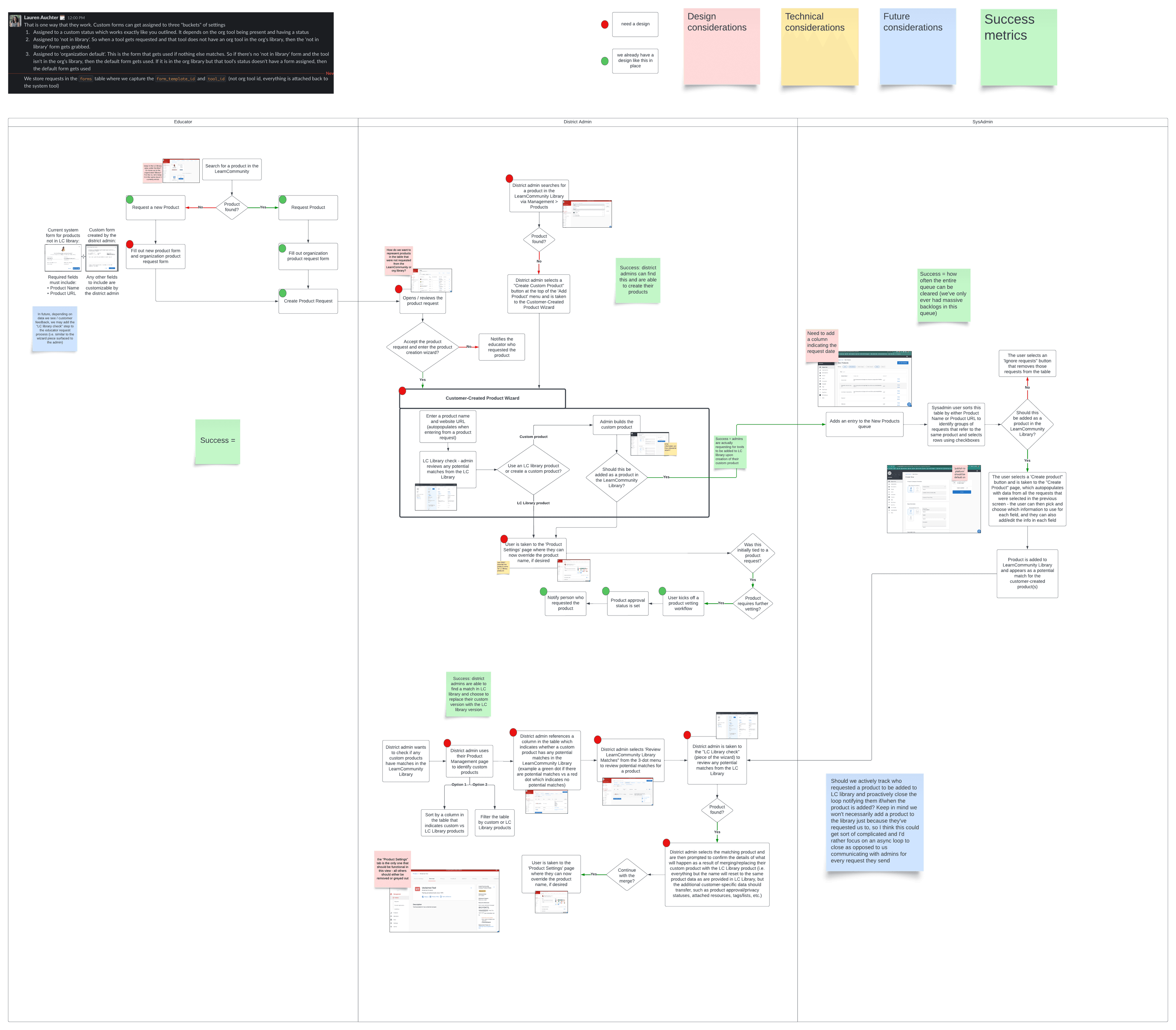
The full system: three roles, shared handoffs, and a path from request to creation and matching.
Choose a detail to inspectRead more about the investigation
Investigation / map the whole journey
I interviewed educators, administrators, contractors, and customer success managers, then mapped the workflow from search through request, review, creation, vetting, and publishing. The map exposed friction and error-prone handoffs.
Investigation / examine the request history
I reviewed 2.5 years of request data to understand processing times, duplicate rates, and contractor effort. Auditing thousands of requests exposed recurring causes: typos, domain changes, and company-name variations.
Finding / make matching more informed
The duplicate patterns informed requirements for richer customer-provided fields and smarter matching against the existing library.
Finding / added does not mean approved
Testing with educators and administrators helped refine language and status messaging before build, addressing confusion between adding a product and approving it for use.
Decision / release the value in stages
A lightweight prototype with contractors and customer success managers revealed an opportunity to separate local creation from backend matching. This enabled earlier value while matching logic was refined.
[04] Solution
Create locally. Connect globally.
Give districts control of product creation, with a path to matching provider-managed products and preserving administrator vetting.
- 01RequestVisible to district
- 02Create locallyImmediate value
- 03VetDistrict workflow
- 04Match & mergeProvider-managed product
- [01]
Local creation
A Custom Product Creation Wizard lets districts create the products they need.
- [02]
Global matching
A backend matching wizard replaces the legacy request system and supports merging with provider-managed products.
Read more about delivery
Prioritize the critical path
I focused scope on immediate time to value, duplicate reduction, and in-platform transparency. Sprint planning and reviews were paired with Kanban flow through design, development, QA, and deployment.
Work through the system constraints
Delivery involved field matching, new product-type tables, and feature tracking. Customer success input helped keep the evolving workflow aligned with power users.
[05] Impact
Less waiting. More ownership.
The published case reports faster time to value, fewer product-request support cases, and deeper administrator engagement.
- Time to value
- Immediate
- Previously ~14 days
- Product-request support cases
- −95%
- Administrator session duration
- +130%
Read more about measurement
Measure the workflow, not just the launch
The initiative tracked duplicates avoided, customer-created product velocity, synced-product adoption, contractor effort, time to value, and support cases. The figures above are reported in the original case study.
[06] Reflection
The handoffs are part of the product.
Creation, matching, and approval serve different purposes. Making those boundaries clear gave districts more control while preserving a shared product ecosystem.
- [01]
Investigate across roles
Follow a request through the people and systems that handle it. Friction often lives between screens.
- [02]
Treat language as behavior
A status label shapes what a person believes they can do next. Test it alongside the workflow.
- [03]
Sequence around value
Separate an immediate customer benefit from the deeper system work needed to sustain it.